Most remote workers are dressing for two audiences now: a camera lens and a coffee shop. The hybrid schedule means you need clothes that survive a 45-minute Zoom call without looking sloppy, then carry you through an in-person meeting without looking like you just rolled out of bed. The solution isn’t buying more clothes. It’s buying fewer, smarter pieces that do both jobs.
After three years of remote work and roughly 2,000 video calls, I’ve learned one thing: the waist-down wardrobe is a trap. You don’t need a full suit rotation. You need five to seven pieces that read as intentional above the shoulders and hold up below them when you actually leave the house.
The Core Problem: Your Camera Lies (And So Does Your Closet)
Here’s what nobody tells you about business casual in 2026: the camera flattens texture, washes out color, and makes anything wrinkled look ten times worse. A shirt that looks fine in your bathroom mirror can look like you slept in it on a 1080p webcam. The fix isn’t ironing more. It’s choosing fabrics that don’t crease in the first place.
Fabrics That Survive a 9AM Call
Merino wool is the undisputed champion here. A merino crewneck or polo from Uniqlo (their extra-fine merino sweaters run $49.90) resists wrinkles, regulates temperature, and looks identical at 8AM and 6PM. I’ve worn the same Uniqlo merino crewneck three days straight on a conference-heavy week and nobody noticed. That’s the goal.
For button-ups, skip the crisp cotton oxfords. They wrinkle the second you sit down. Go for a knit button-up instead. The Everlane Performance Oxford ($68) is a polyester-cotton blend that drapes well and doesn’t crease. It’s not as breathable as pure cotton, but for a two-hour call in an air-conditioned apartment, it’s perfect.
The worst choice? Linen. I love linen. Linen is a lie on camera. It creases if you breathe near it. Save it for in-person summer events where the wrinkles read as intentional.
The Color Rule Nobody Follows
Dark colors swallow you on camera. White blows out. The sweet spot is mid-tone colors: olive, rust, muted blue, heather gray. These read clearly on a webcam without making you look like a floating head. I’ve tested this against a cheap Logitech C920 and a MacBook Pro camera. Mid-tone always wins.
Avoid busy patterns smaller than a quarter. They moiré on camera — that weird shimmering effect that makes a fine-check shirt look like it’s vibrating. Solid colors or large-scale patterns only.
What Actually Works: A 7-Piece Remote Capsule

If I were starting from scratch tomorrow, here’s exactly what I’d buy. Total cost: around $450. That’s less than two pairs of designer jeans and covers every remote work scenario for a year.
| Piece | Specific Pick | Price | Why It Works |
|---|---|---|---|
| Merino crewneck | Uniqlo Extra Fine Merino | $49.90 | No wrinkles, temperature regulation, camera-friendly |
| Knit button-up | Everlane Performance Oxford | $68 | Drapes well, machine washable, no ironing |
| Chino pants | Bonobos Stretch Washed Chinos | $98 | Comfortable for sitting, presentable for in-person |
| Cardigan | COS Oversized Wool Cardigan | $120 | Layers over anything, reads as intentional |
| Structured tee | Buck Mason Field Spec Tee | $45 | Thick collar, holds shape, doesn’t look like underwear |
| Minimal sneaker | Veja Campo | $165 | Clean enough for casual office, comfortable for errands |
| Dark denim | Everlane 90s Cheeky Jean | $98 | No distressing, dark wash reads as smart casual |
You’ll notice what’s missing: no blazers, no dress shoes, no ties. For remote work in 2026, those are overkill unless you’re in finance or law. A blazer on a Zoom call looks like you’re trying too hard. A merino crewneck reads as competent and relaxed.
The Waist-Down Trap (And How to Escape It)
I spent my first year of remote work wearing gym shorts below the desk and a nice shirt above it. Then I had a surprise in-person meeting and had to scramble. The lesson: always have one pair of presentable pants within reach. Not necessarily on your body, but clean and ready.
The best remote work pants are stretch chinos. The Bonobos Stretch Washed Chinos ($98) feel like sweatpants but look like proper trousers. They have enough stretch to sit cross-legged in a desk chair for hours, and they don’t bag out at the knees. I own three pairs in navy, olive, and stone.
What to avoid: anything with an elastic ankle cuff. Joggers are comfortable, but they read as athleisure on camera and are a dead giveaway that you’ve given up. If you must wear joggers, get a pair without a visible cuff — the Lululemon ABC Jogger ($128) is the only exception I’d make, and only because the cuff is subtle enough to pass as a tapered trouser in low light.
For women, the equivalent is the MM.LaFleur Foster Pant ($195). Pricey, yes, but they’re made from a ponte knit that looks like suiting fabric and feels like pajamas. Worth it if you’re on camera daily and need to look polished without sacrificing comfort.
When NOT to Buy Anything New
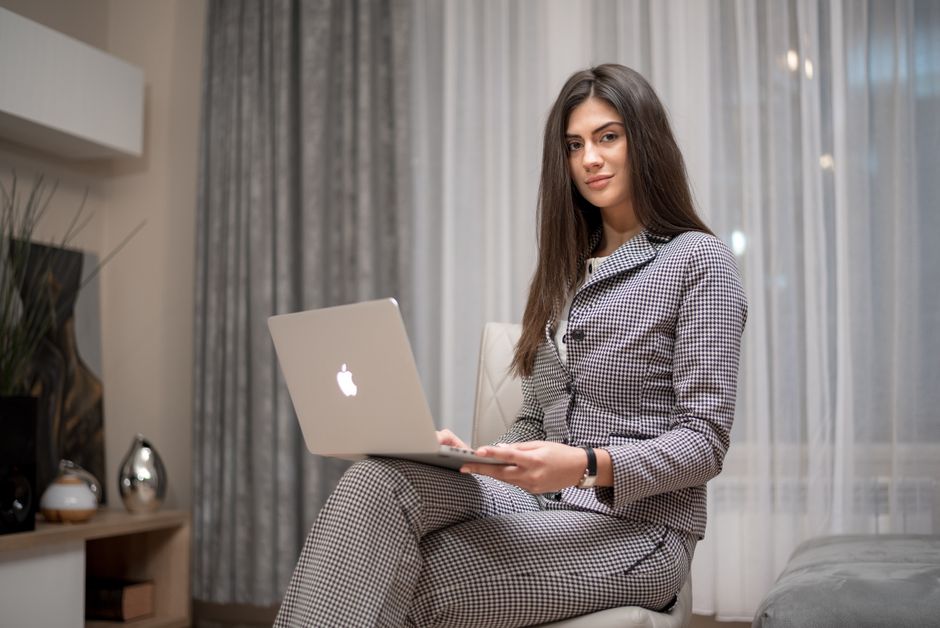
Before you spend a dollar, audit what you already own. Most people have 80% of a remote work wardrobe sitting in their closet. The problem isn’t lack of clothes. It’s lack of a system.
Pull out every top you own. Check it against three tests:
- Wrinkle test: Scrunch it in your fist for five seconds. If it holds visible creases, it’s not camera-ready.
- Collar test: Does the collar stand up on its own, or does it flop? A floppy collar reads as sloppy on camera.
- Color test: Hold it up to your face in natural light. Does it make you look washed out or sallow? If yes, it’s not doing you any favors on a webcam.
Anything that fails all three tests goes in a donation pile. Anything that passes goes on a hanger facing the wrong way. After a month, you’ll see what you actually wore.
The most common mistake I see: people buy a whole new wardrobe before they understand what they already have. Don’t do that. Wear what you own for two weeks. Note what you reach for repeatedly. Then fill the gaps.
My Verdict: Spend Money on Fabric, Not Brand Names

The difference between looking put-together on a video call and looking like you just woke up isn’t the brand. It’s the fabric. A $200 polyester shirt from a designer label will look worse on camera than a $50 merino sweater from Uniqlo. Every time.
Prioritize natural fibers with stretch: merino wool, cotton-spandex blends, ponte knit. Avoid anything that’s 100% polyester unless it’s specifically engineered for performance (the Everlane Performance Oxford is the exception, not the rule).
For most remote workers in 2026, the right wardrobe is: two merino crewnecks, one knit button-up, one cardigan, two pairs of stretch chinos, one pair of dark denim, and one pair of clean sneakers. That’s it. Seven to eight pieces. Everything coordinates, everything survives a camera, and everything works if you suddenly have to go into the office.
Spend the money you save on a decent webcam and a ring light. Those will do more for your professional appearance than any designer shirt ever will.